01 / The short answer
Start with the surfaces your water actually touches.
A glass pour-over brewer is a straightforward place to start if you want an easy-to-inspect setup. For automatic brewing, look for a component-level materials list and check the seals as well as the tank. “Plastic-free” on a product page does not necessarily mean free of silicone, free of every polymer, or proven to reduce microplastics in your cup.
Compare the three options02 / Understand the claim
What to know about plastic in coffee makers
Before choosing a coffee maker without plastic, define the part of the machine you care about. A plastic control button outside the brewing area is different from a plastic reservoir holding water. A metal case does not tell you what is inside it.
The outside
Housing, handles and controls. These may not touch the drink.
The brew path
Every surface water or coffee touches, from the reservoir through to the cup.
The small parts
Seals, valves and connectors. Ask about these even when the main parts are glass or metal.
Use “BPA-free” as a claim about BPA, not proof of the absence of plastic, BPS, PFAS or every other substance. For a specific chemical question, ask for documentation covering the exact model and contact component. We do not infer a machine’s composition from a generic study of another material or product.
The FDA says current evidence has not demonstrated a human-health risk from the levels of microplastics and nanoplastics detected in food, while substantial research gaps remain. That does not measure any of the machines in this guide. We make no claim that switching brewers prevents illness or produces a microplastic-free drink. Read the FDA’s assessment ↗
03 / Look inside the machine
The hard part: verifying an automatic brew path
An automatic machine can hide the very components you want to inspect. A product photo may show the carafe and basket but tell you nothing about a valve or connector. Ask for a materials list that covers both cold and hot water contact.
The specifications below illustrate why wording matters: one brand explicitly lists silicone, while another describes key metal components without giving us a complete inventory. Treat an omission as an unanswered question. It is not proof that the missing part is plastic, or that it is plastic-free.
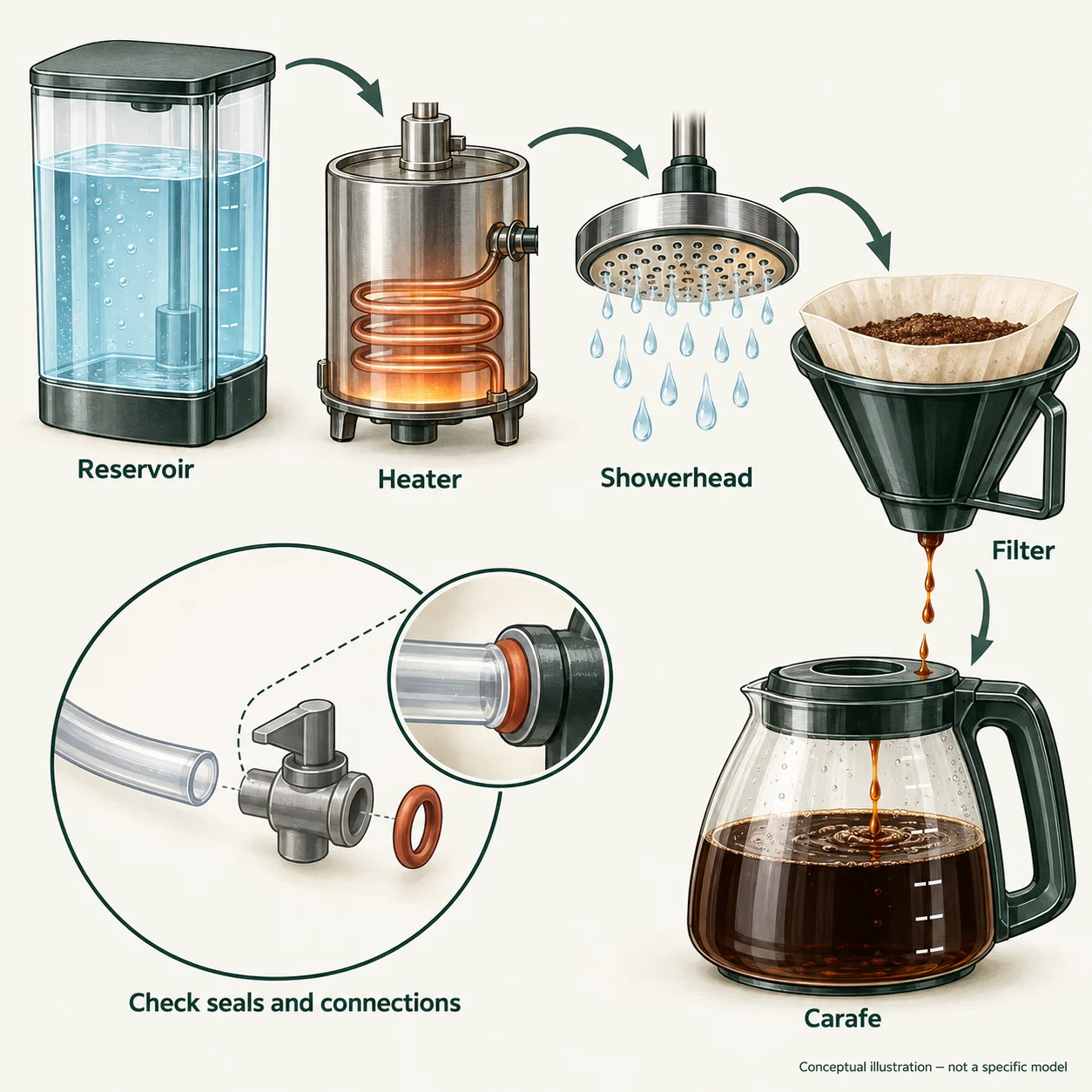
“For this exact model, what materials contact cold water, hot water and brewed coffee—including the reservoir, tubing, valves, seals, filter holder and carafe lid? Please identify any silicone, plastic or coatings.”
04 / A materials checklist
Glass, stainless steel and ceramic: what to check
These are shopping checks, not a universal safety ranking. Evaluate the finished product and its intended use, rather than treating a material name as a guarantee.
- Glass: identify the vessel material and inspect lids and filter supports separately. Include your kettle when assessing the setup.
- Stainless steel: look for a documented grade and a description of the internal contact surfaces, not just a stainless exterior.
- Ceramic: check the maker’s food-contact documentation for the finished glaze. Appearance alone cannot establish its composition.
- Silicone: record where it is used. If your personal requirement excludes synthetic polymers altogether, ask specifically about silicone rather than relying on a plastic-free label.
- Filters: check the exact filter product and any material claims separately from the brewer.
05 / Compare your options
Three routes to a more transparent brew path
These are candidates selected for different routines and available documentation—not winners of a taste test. We have not personally tested these products.
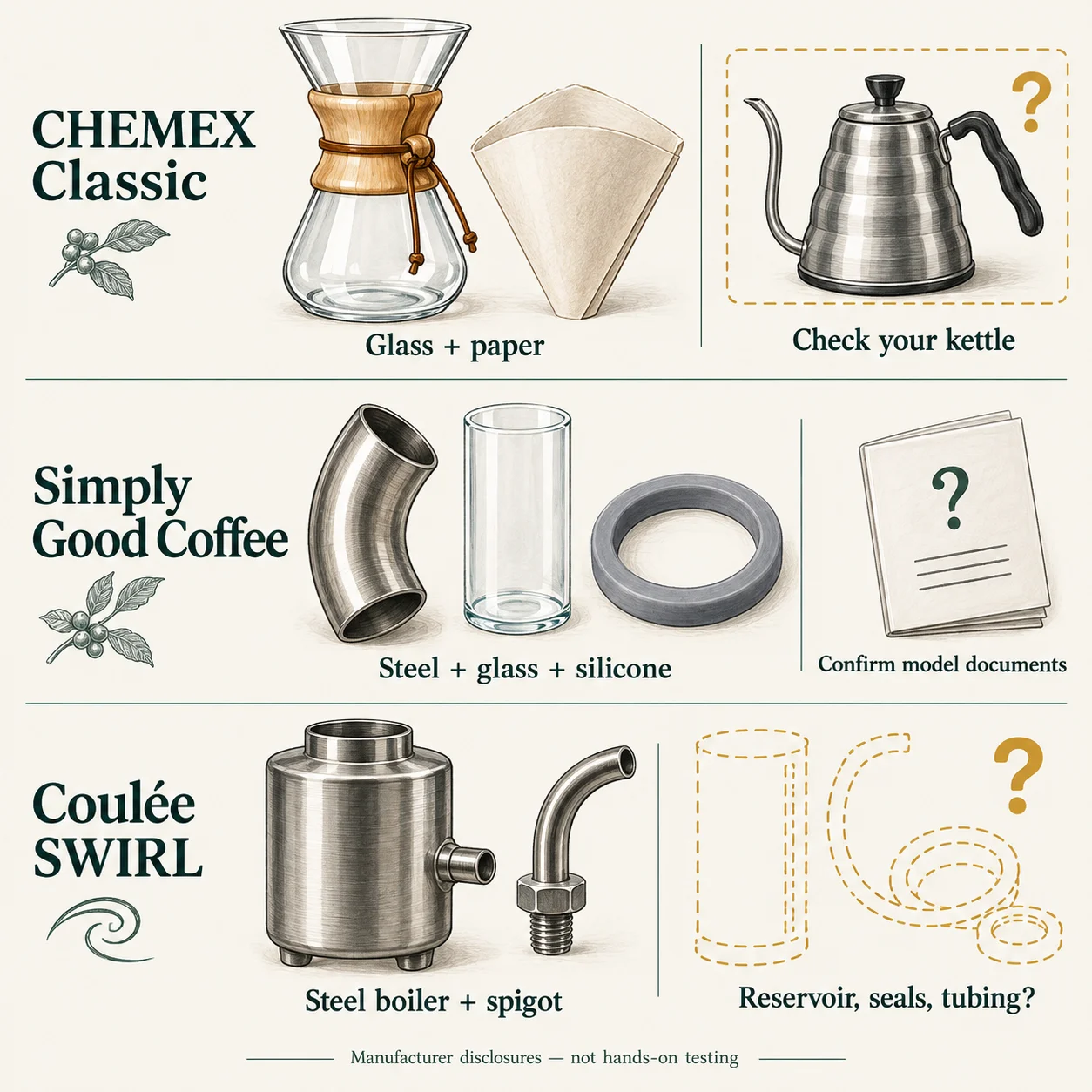
| Coffee maker | Routine | Listed price | Key limitation |
|---|---|---|---|
| CHEMEX Classic | Manual | $49.50 | Separate kettle |
| Simply Good Coffee | Scheduled drip | $469.99 | Includes silicone |
| Coulée SWIRL | Single-serve | $174.99 | Incomplete materials inventory |
USD prices are dated observations, not live offers. Verify the exact model, price, shipping and stock with the seller.
CHEMEX Classic 6-Cup
- Materials, per manufacturer
- Borosilicate glass brewer, used with a paper filter. Wood collar and leather tie sit outside the brew path.
- Capacity
- 30 fl oz
A straightforward option if you are happy to pour by hand. The open construction makes the coffee-contact surfaces easy to inspect.
You need a separate kettle and compatible filters. Check the kettle’s water-contact materials too; the brewer alone cannot establish the materials of your entire setup.
Simply Good Coffee — The Brewer
- Materials, per manufacturer
- The maker lists 304 stainless steel for the boiler, internal plumbing, shower parts, basket and carafe top; borosilicate glass for the reservoir, boiler tube and carafe; and silicone for the reservoir cover, lid seal, connectors and drip stop.
- Capacity
- 40 fl oz / 8 maker-defined cups
A candidate if you want a plastic-free coffee maker with a timer: the listed timer can schedule a brew up to 24 hours ahead.
The brand’s plastic-free claim includes silicone. If you want to avoid all synthetic polymers, this does not meet that stricter preference. We have not independently inspected its internals.
Coulée SWIRL Brewing System
- Materials, per manufacturer
- Coulée describes a stainless steel boiler and spigot, paired with its paper EcoPour filters.
- Capacity
- 6–12 fl oz of input water per brew, per the SWL001 manual; finished coffee volume will differ
A single-serve candidate for people comparing automated pour-over systems with fewer plastic contact surfaces.
The SWL001 manual identifies plastic exterior surfaces, and a complete reservoir, seal and tubing materials inventory is still missing. The sales page displays a sold-out/waitlist message alongside purchase controls. Confirm the exact model and stock before ordering.
CHEMEX: the maker identifies borosilicate glass and describes its filter paper as virgin pine pulp. That does not independently establish a PFAS-free or zero-release claim. Materials and filter details ↗
Simply Good Coffee: the product page listed the programmable brewer in stock when checked. Its linked shared manual is dated August 2024 and gives a different power rating from the current listing. The linked 2022/2023 analysis concerns the Olson brewer and brewing performance; it does not establish material-release results for this programmable model. Ask for model-specific documentation before relying on certification claims.
Coulée: the SWL001 manual specifies 6–12 fl oz of input water and mentions plastic exterior surfaces. This is not evidence of plastic in the hot-water path, but it rules out describing the whole appliance as plastic-free. Its cold-water reservoir, seals and tubing still need a complete materials list. Official support and SWIRL manual ↗
Our reading of the evidence: choose your preferred routine first, then decide which unresolved materials questions you are willing to accept. A less convenient machine with a clearer materials list may suit you better than an automatic machine with incomplete disclosure.
06 / Before replacing anything
If you already own a plastic machine
You do not need to make a purchase to start investigating. Find the exact model number and its manual. List the parts that touch water or coffee, then ask the manufacturer about the ones you cannot identify.
Follow the machine’s cleaning, descaling and replacement instructions. Do not remove seals or modify internal plumbing to eliminate a material. If you decide to switch, compare the complete setup—including the kettle, filter and cup—against your own requirements.
A replacement can satisfy a materials preference. This guide cannot promise that it will improve your health.
07 / Common questions
A few things worth clearing up
Are there any coffee makers that don’t use plastic?
Some simple glass brewers let you inspect the coffee-contact path easily. For an entire setup, check the kettle, filter and accessories too. Automatic makers may use “plastic-free” while still listing silicone. Decide whether your requirement concerns the brew path, the whole appliance, or all synthetic polymers.
Is there an automatic drip coffee maker without plastic parts?
A claim about the brew path is narrower than a claim about every part of an appliance. Ask the manufacturer for a complete inventory if you want the latter. The programmable option above includes disclosed silicone, so we do not describe it as polymer-free.
Which coffee maker has the least amount of microplastics?
We cannot rank these products by microplastic release. We have not obtained comparable measurements from a shared testing method. Material specifications alone do not provide that measurement.
Should I worry about plastic in a coffee maker?
This guide cannot estimate your personal exposure or health risk. The FDA assessment explains the current evidence gaps. If you prefer less plastic contact, use the materials checklist to make a documented choice.
Which coffee maker is the healthiest?
We do not have evidence to award that label. We compare materials and purchasing trade-offs, not health outcomes.
Are these hands-on “no plastic coffee maker reviews”?
No. This is a comparison of manufacturer specifications and published product documentation, prepared with AI assistance. We have not evaluated flavor, long-term reliability or material release through our own testing.
08 / Show the work
Sources and research method
We checked these primary sources on September 28, 2026. Manufacturer statements are attributed claims, not independent verification. Our recommendations explain the practical trade-offs we infer from them.
- CHEMEX product details ↗
- Simply Good Coffee specifications ↗
- Coulée product details ↗
- CHEMEX: Materials & Process ↗
- Simply Good Coffee: shared manual (August 2024 PDF) ↗
- Simply Good Coffee: Olson brewing analysis (2022/2023 PDF) ↗
- Coulée: Support, FAQs and SWIRL manual ↗
- FDA: Microplastics and Nanoplastics in Foods ↗
We have not inspected the products, analyzed samples or assessed owner-review datasets. Certifications and “zero release” claims are not independently established here. The homepage diagram and AI-generated article illustrations explain concepts and material categories. They are not product photographs, verified internal layouts or evidence of hands-on testing.
More about our editorial approach